9 Red Flags When Hiring a Web Designer (Protection)
Stop risking thousands on web agencies. Get a custom local business website with $0 upfront and no contracts. See your free preview before paying a cent.
By George Suarez, Founder at We Got Sites
I've spent years in tech, startups, and SaaS. I helped bigger companies grow with systems, data, and technology. Then I took everything I learned and pointed it toward local businesses, because that is where I saw the biggest gap.
Small businesses are the backbone of the US. They are run by families, regular people, and a lot of owners who did not grow up with resources or connections. I identify with that. I came from a family without a lot of resources, so I understand what it feels like when every dollar has a purpose.
And that is why this topic matters.
A bad website decision does not just waste money. It can hit payroll. It can delay equipment. It can take away from groceries, tuition, or time with your family. Bigger companies can survive bad tech decisions a lot easier. Family businesses feel them fast.
Bigger companies are also getting more tech-enabled and AI-driven every year. I do not want small businesses getting left behind. I care about making technology and resources accessible for everyone, without feeling like their whole wallet's on the line.
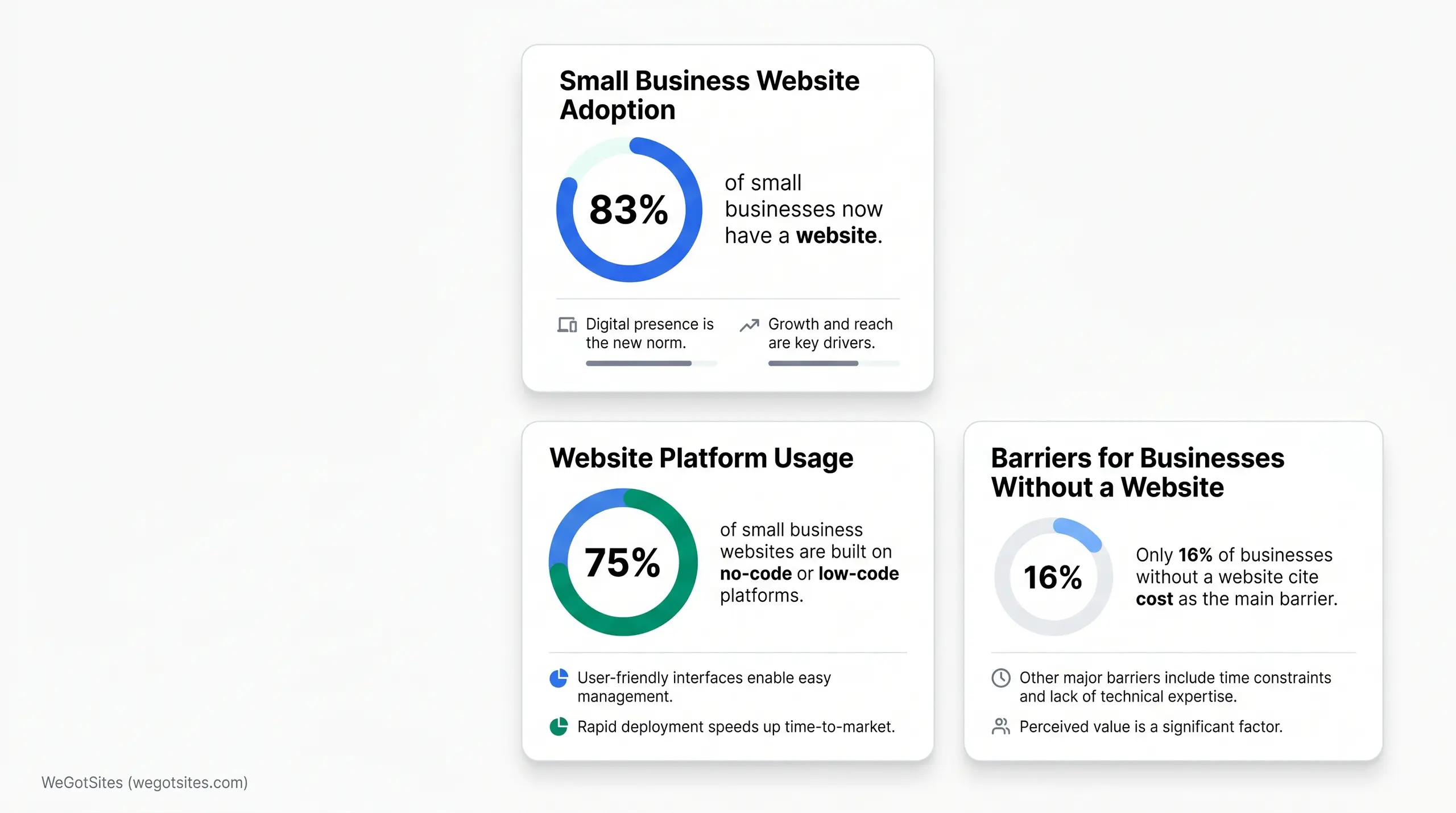
The market has changed too. Clutch says 83% of small businesses now have a website. The same report says 40% name SEO as their top lead source. Being online is normal now. The real question is whether your site actually helps you win.
The Question Behind Every Red Flag
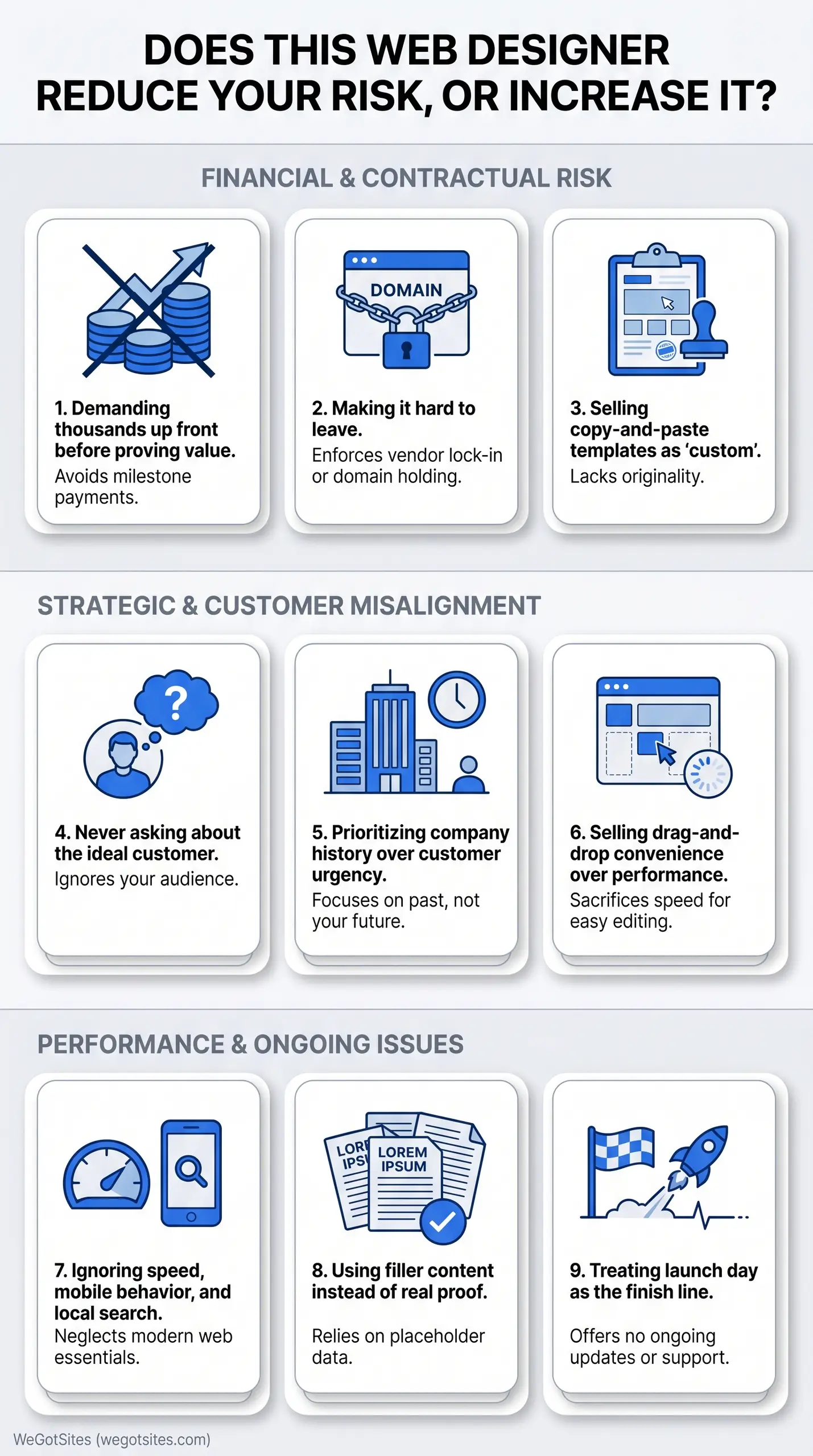
Here is the question I want you to keep asking: does this web designer reduce your risk, or increase it?
That one question will save you a lot of pain.
Most businesses do not get burned because they are careless. They get burned because they do not know what questions to ask. So let's fix that.
1. They Want Thousands Up Front Before You See Real Value
Agencies deserve to get paid. I have no issue with that. The problem starts when the whole model protects the agency first and leaves all the risk on the business owner.
I've said this before and I mean it. For a bootstrapped local business, the hesitation is rarely just about price. The hesitation is about risk. Family businesses do not make decisions on big blind bets. They make decisions on cash flow, timing, and whether they can afford to be wrong.
Even the market points to that. Clutch found that only 16% of businesses without a website cite cost as the main barrier. That tells you a lot. Owners are worried about more than money. They are worried about making the wrong move.
So if a designer asks for $3,000, $5,000, or $10,000 before proving anything, I pay attention. That pricing model tells me where the incentives are. The agency gets paid first. You hope it works later.
That is why I tell owners to ask direct questions. What do I get before I pay? How are you reducing my risk? What happens if the first direction misses? If those answers are fuzzy, you need to slow down.
2. They Make It Hard to Leave
A real partner gives you flexibility. A bad vendor gives you obligation.
This one is simple. Ask yourself one question. Can I walk away if this stops working for me? If the answer is no, you are looking at a lock-in problem.
I tell people to watch for three things right away. First, who owns the domain? Your domain is your name on the internet. If you do not control that, you are exposed. Second, are there penalties to leave? Third, can they clearly explain what they do every month?
A lot of agencies hide behind words like maintenance, security, and updates. Those things matter. Hosting matters. SSL matters. Backups matter. But none of those should be used to trap you.
You should feel more in control after hiring a web partner, not less. If the contract already makes you feel stuck before you sign it, that feeling is only going to get worse later.
3. They Say "Custom," but It Feels Like Copy and Paste
I spoke with a contractor who had paid over $6,000 for what he was told was a custom website. A few weeks later he was scrolling another contractor's website in his area. He told me that for a second, he thought maybe he had clicked his own website by accident.
Same layout. Same sections. Same order. Even the wording felt familiar.
That bothered him more than the price.
He was not even angry at first. He was disappointed. He told me, "I didn't mind paying. I just thought it would actually be different."
That is the red flag. Repeatable structure can exist. Charging custom prices for non-custom thinking is where the problem starts. When your site feels replaceable, your business starts feeling replaceable too.
So ask the designer to show you two sites they built in your industry. Then ask them to explain the differences. I do not mean different colors. I mean different positioning, different messaging, different customer targeting. Ask them what parts are built for your business specifically. If they dodge that question, listen closely.
Most business owners do not know what to ask, and that is how they end up overpaying for a copy-and-paste job.
4. They Never Ask About Your Ideal Customer
This is one of the easiest ways to tell whether someone is strategic or whether they are just decorating a page.
If a web designer never asks who your ideal customer is, what kind of jobs you want more of, what service brings the best margin, or what areas you want to target, they are building blind. They may still give you something pretty. That does not mean it will bring in the right leads.
Your website decides which customers you hear from. It can pull in better jobs. It can also quietly fill your pipeline with price shoppers.
I've seen a local home service business replace a weak DIY site with stronger premium messaging and a better structure. The lead quality changed. The projects got bigger. The close rate got faster. And the price-shopping questions slowed down. That is what happens when the site is built around the right buyer.
High-paying homeowners think differently, search differently, and choose differently. They want confidence. They want proof. They want to feel like you specialize in what they need. Generalists attract average clients. Specialists attract premium clients.
A serious designer should ask you who you want to attract, what outcome you provide, and what kind of jobs you are tired of getting. If they spend more time asking about colors than customers, that is a red flag.
5. They Put Your Story Above the Customer's Urgency

I respect company history. I respect family-owned businesses deeply. If you have survived on word of mouth for years, that usually tells me you do a great service.
But the buyer's behavior has changed.
Before, referrals were enough. Now referrals trigger research. Word of mouth gets you considered, but your online presence decides if you get chosen. People do not blindly trust anymore. They verify.
I've seen family-owned service businesses lead their homepage with their history, their founding year, and a long story about who they are. Then the leads stay inconsistent. We moved that story lower on the page, pushed the services, locations, and proof of work higher, and the quality of the leads improved. Prospects came in more sold before they even called.
The order matters.
A buyer's brain usually asks three questions in a row. Can you help me? Do I trust you? Then who are you? Your story matters, but it needs to show up after you earn the attention to tell it.
I sat with a homeowner who looked up a highly recommended contractor for a high-ticket job. The referral was strong. The contractor had real skill. But after three or four seconds on the website, the homeowner backed off and said, "If I'm spending this much, I just want to feel sure."
That is how fast doubt shows up online.
Your homepage has to pass the 30-second test. A customer should understand what you do, whether you serve their area, and how to contact you almost immediately. If a designer wants to lead with "Welcome to our website" or "Family owned since 1998," I would push back hard.
6. They Sell Drag-and-Drop Convenience as the Main Value
I hear this pitch all the time. "We build it on WordPress, Webflow, or Squarespace so you can edit everything yourself."
I understand why that sounds attractive. It feels like control.
But easy editing can create a different problem. A lot of those sites are built for ease of use, not performance. Agencies can move fast. Owners can drag things around. And six months later the site is bloated, inconsistent, slower, and weaker at converting.
Clutch reports that 75% of small business websites are built on no-code or low-code platforms. That helps explain why so many local sites feel the same and perform the same.
I also think too much editing freedom backfires for a lot of owners. They are experts at their trade. They are not always experts in conversion, structure, or buyer psychology. So they start making changes that feel right to them, but those changes are built more for them, not ideally their customer.
I've seen the damage from the DIY side too. We worked with a car wash company that had a five-year-old website built by a nephew. The site had become hard to access and it was actively devaluing the brand. We rebuilt it from scratch with zero upfront risk because the owner needed something that looked like a real business asset.
Platform alone does not decide success. The thinking behind the build matters more. A strong builder can make different tools work. A weak strategy stays weak on any platform.
7. They Ignore Speed, Mobile Behavior, and Local Search
This one quietly costs business owners a lot of money.
Most local buyers are on their phones. They are searching between tasks, during lunch, in the truck, or while dealing with a problem at home. They want speed. They want clarity. They want a direct way to call or text.
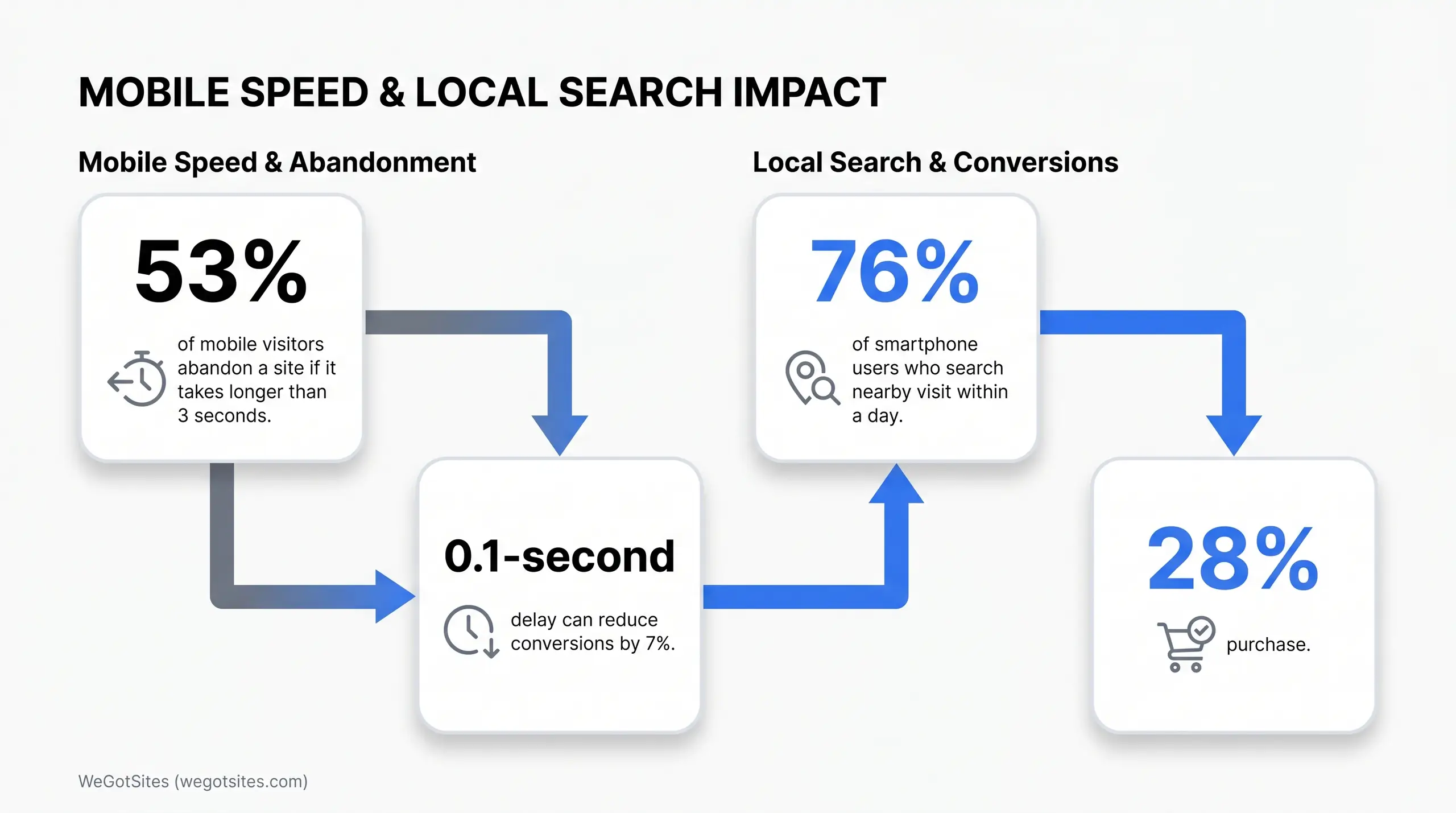
The data backs that up. Akamai found that 53% of mobile visitors abandon a site if it takes longer than three seconds to load. The same study found that a 0.1-second delay can reduce conversions by about 7%. That is why I keep saying speed matters. Speed is the difference between staying and bouncing.
BrightLocal found that 61% of mobile users are more likely to contact a local business if the site is mobile-friendly. It also found that 52% care most about the physical address on a local business website. So if your designer hides your service area, phone number, or address behind clutter, you are losing people fast.
And local intent is strong. A Google report found that 76% of smartphone users who searched for something nearby visited a related business within a day, and 28% of those searches led to a purchase. That is serious buying intent.
So what should a designer already be talking about? They should be asking about your Google Business Profile, your reviews, your service-plus-city pages, and whether your name, address, and phone are consistent across the web. If you already rank for certain pages, they should have a plan to preserve that traffic and redirect it properly during a rebuild.
And for emergency services, I keep it even simpler. Sometimes people just want to talk to people. If a designer wants to hide the phone number behind a chatbot on a plumbing or HVAC site, I would be careful. A stressed buyer is not looking for cute. They are looking for help right now.
8. They Fill the Site with Filler Instead of Proof
Stock photos of people shaking hands do not build trust. Generic copy about quality service does not build trust either. Real proof does.
I've felt this myself. When I moved to a new city, I had friends recommend barbershops to me. I still looked them up online. And if I could not find real photos showing haircut quality, I kept moving. The recommendation got them considered. The missing proof stopped the decision.
That same pattern shows up in local services every day.
If the website does not match the quality of the work, buyers lose trust and faith in the quality of the work. A weak site can lose a customer before they even read a word. And premium homeowners usually do not complain when this happens. They do not send feedback. They quietly leave and hire someone else.
I've also seen what happens when the site starts speaking to better buyers. One local home service business had an outdated nephew-built site that kept attracting price shoppers. After the site was rebuilt with stronger premium messaging, the conversations changed. People stopped asking if they were the cheapest. They started asking when they could start.
That is why I tell owners to show proof, not promises. Use real project photos. Use before-and-after work. Use testimonials with full names. Speak about outcomes, not just services. If you want high-paying jobs, your website has to make people feel safe spending real money with you. You have to look expensive before you charge expensive.
9. They Treat Launch Day Like the Finish Line

A website should be a living sales tool. It needs updates. It needs better photos. It needs tighter copy. It needs fresh reviews. Sometimes it needs a new page. Sometimes it needs a design refresh. Sometimes it needs a better path for people to call, text, or fill out a form.
Healthy businesses keep improving their sites. Clutch found that 61% of small businesses update their website at least weekly. The same report found that 81% have redesigned their site at least once. That tells you the website is never really done.
I've seen what happens when owners are left alone after launch. DIY websites fail slowly. Three to six months go by. The owner keeps hoping the site will start working. Meanwhile competitors are taking the missed revenue.
I also spoke with a client who had already wasted $600 on an agency that built a poor website and then refused to make edits. That kind of experience makes people skeptical for a reason.
So ask how updates work after launch. Ask how fast they respond. Ask whether they charge you every time you want to swap a photo or change text. If the site cannot evolve with the business, it gets stale fast. And if your business misses calls because you are out in the field, a good partner should at least think through forms, text options, or other ways to capture that lead.
Most agencies sell pages, design, and features. Most business owners care about calls, leads, and revenue. I always come back to that.
Final Thought
I built WeGotSites because I wanted to bring in that enterprise feeling for these small businesses. I wanted local business owners to have access to the same level of thinking larger companies use, without forcing them into a huge upfront gamble.
That is why I built my model around risk removal. We do free website previews before a client pays a cent. We keep it month to month. No contracts. We custom-code the sites. We make them mobile-first. We include the basics owners actually need, like the domain, hosting, SSL, and backups. And we keep updates simple, because businesses need the ability to grow at the pace they are growing.
But even if you never work with me, I want you to protect yourself.
Ask direct questions. Make the designer explain things in plain English. Watch how they answer. If they cannot clearly tell you how the site will help you get found, build trust, and get more calls, keep moving.
You deserve a chance to win online. And you deserve to do it without feeling like your whole wallet's on the line.
Frequently Asked Questions
Do digital ads actually help small local businesses compete?
Yes, they level the playing field. According to the Connected Commerce Council, 75% of small business leaders say digital ads help them compete with much larger competitors. If your site is built properly, it will convert those paid clicks into actual phone calls, ensuring your budget isn't wasted.
Is it a red flag if a designer guarantees page one on Google?
Absolutely. Nobody can guarantee the number one spot on Google. If an agency promises that, they are selling a scam that puts your hard-earned money at risk. Real SEO takes time and structural discipline. A trustworthy partner focuses on consistent local search strategy, not empty, overnight promises.
Should my web package include a custom business email address?
Yes, it absolutely should. Operating from a generic email address hurts your credibility with high-paying clients. A professional web designer must include a custom, branded business email to signal trust. If they nickel-and-dime you for basic professionalism, that is a clear sign to walk away.
Can I just rely on Facebook instead of paying for a website?
No, relying entirely on social media is a massive risk. You do not own those platforms. Furthermore, recent data shows 83% of small businesses now have dedicated websites, with 40% citing SEO as their top lead source. Without a site, you are quietly handing high-intent local leads to your competitors.
Is it a red flag if they charge extra for backups and SSL?
Yes, nickel-and-diming for basic security is a massive warning sign. Features like SSL protection and daily backups are non-negotiable for keeping your family business safe online. They must be included in your core package. If an agency treats essential security as an upsell, they are prioritizing their margins over your safety.