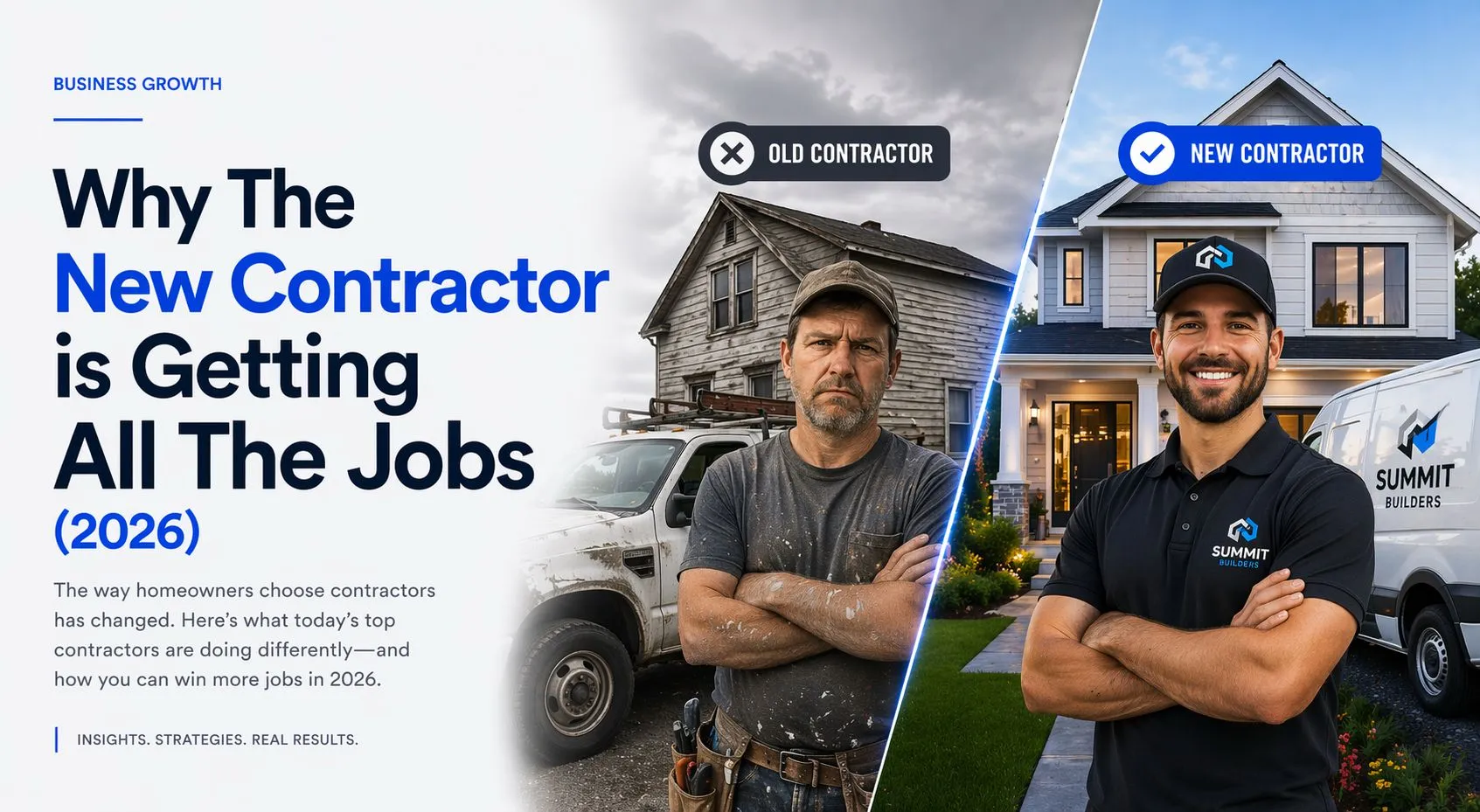
Why The New Contractor Is Getting All The Jobs (2026)
Discover why newer contractors win more jobs and how your website, reviews, and online trust signals influence who homeowners choose.
By WeGotSites Editorial, Founder at We Got Sites
If you're a contractor and a newer company keeps landing the jobs you wanted, I can tell you where the gap usually is.
The customer felt safer with them.
That feeling happened fast. It happened online. And it happened before anybody picked up the phone.
I'm not here to tell you how to run crews, price a remodel, or manage a job site. You already know your trade. I'm here to tell you what I keep seeing on the digital side, because this is where great contractors are quietly losing work they should be winning.
I spent years in tech, startups, and SaaS helping mid-market and enterprise companies grow with systems, technology, and data. Then I looked at local businesses and saw a huge gap. The same tools that help bigger companies win online were never really made accessible to the backbone of the US, which are small businesses.
That matters because there are now 36.2 million small businesses in the U.S.. They make up about 99% of all firms. They also created 1.2 million net new jobs in a single year. When local businesses get left behind online, families feel it. Communities feel it too.
Word of mouth still matters, but it no longer closes the job
If your business grew on referrals, I respect that.
Relying on word of mouth for so long is amazing because it usually means you do a great service. It means people trust you. It means your work held up long enough for people to tell other people about it.
But the market changed.
Before, referrals were enough. Now referrals trigger research.
BrightLocal found that 87% of consumers used Google to research a local business. It also found that 76% of consumers regularly read online reviews. Another 46% say reviews are as trustworthy as personal recommendations.
That tells you exactly what changed.
The referral gets you considered. Then the homeowner grabs their phone. They Google your name. They look at your site. They scan your photos. They check your reviews. They compare you to two or three other names they already have.
So when I say word of mouth gets you considered, but your online presence decides if you get chosen, I mean that literally.
If someone got a referral, they probably got two or three other referrals. The one who confirms trust the fastest usually gets the call.
The job gets lost at the verification step
I saw this happen in real life, and it stuck with me.
I was sitting with a homeowner who needed a high-ticket project done. Her neighbor gave her a contractor and said he was amazing. He had been doing it for years. So the trust was already there. He had basically won on paper.
She pulled out her phone and said, "Let me look him up really quick."
She typed the name into Google. Up came a basic website. Old design. Small text. No clear headline. A couple generic stock photos. Maybe two or three reviews. She looked at it for three or four seconds and said, "I don't know."
Then she opened another tab.
The next contractor had a cleaner website. Bigger photos. Clearer messaging. Stronger project shots. An easy request-a-quote button. Her reaction changed right away. She said, "Oh, this one looks great."
She never called the first guy.
The part that stayed with me most was what she said next: "If I'm spending this much, I just want to feel sure."
That's it. That's the whole thing.
The referral created trust. The website introduced doubt. The doubt won.
And this reaction is not rare. About 75% of consumers judge a company's credibility by its website design. Premium homeowners usually do not complain about this. They do not send you feedback. They do not tell you your site made them nervous. They quietly leave and hire somebody else.
Those are the most expensive losses because you never even see them happen.
Premium homeowners scan for confidence
A lot of contractors think premium buyers read every word on a website.
They don't.
They're scanning it for a feeling.
The question in their head is simple: Does this feel like someone I trust with my home and my money?
Premium homeowners don't choose the best contractors. They choose the one they feel most confident hiring. At the high end, decisions are made on confidence.
Clarity builds trust faster than history
The first few seconds matter most.
People want to know what you do, where you work, why you're better, and what they should do next. If your homepage opens with "Welcome to our website" or "Family owned since 1998," you are asking the customer to care about your story before you answered their question.
Customers don't trust you because of your story. They trust you because they believe you can help them.
That is why I build around the customer's natural decision flow. First they want to know, can you help me? Then they want to know, do I trust you? After that, they care who you are.
Your story matters. I respect family businesses deeply. I come from that world. But your story belongs after the customer sees themselves in the solution.
I've seen what happens when owners make that one change. A family-owned service business had their history front and center on the homepage. We moved it lower and put the service, location, and proof of work first. The quality of the leads changed. More of the people calling were already sold before they even picked up the phone.
That is why I keep saying the same thing: your story matters, just not in the first five seconds.
Specialists feel safer than generalists
Premium buyers want clarity in the service too.
If your site says, "We do it all" or "No job is too big or small," it feels generic. It feels average. If your site clearly shows the type of work you are best known for, it feels stronger.
Generalists attract average clients. Specialists attract premium clients.
This also changes the kind of language you use. Speak about outcomes, not services. Wealthier clients buy results, not tasks. They want the stress gone. They want the finish to look right. They want the home value protected. They want the project to feel safe.
If you are trying to attract high-paying homeowners, avoid cheap language. High-paying homeowners associate cheap with risk. They want confidence, not bargains.
Real proof beats generic claims every time
Premium homeowners want proof, not promises.
They want real project photos. Real before-and-after shots. Real testimonials with full names. They want to see that you have done work that matches the result they already have in their head.
If you are a construction company working in a wealthy area, your website needs to reflect the level of work you are trying to sell. If the website doesn't match the quality of the work, buyers lose trust and faith in your quality before they even read a word.
That is why I hate filler. Stock photos of people shaking hands. Fake smiling families. Generic office pictures. Those things do not prove anything. Real photos make the business feel real.
I've seen this in my own life too. When I moved to a new city, people recommended barbers to me. But if I looked them up and could not find photos showing the quality of the haircut, I did not go. The recommendation got them considered. The lack of visual proof kept them from getting chosen.
That same thing is happening to contractors every day.
Speed and simplicity matter more than flashy design
The user experience is more important in my opinion than the user interface.
You can have both. You can have a site that looks good and converts. But if I have to choose, I will pick the website that is clear, fast, and easy to act on every single time.
Homeowners do not want a puzzle.
Wegotsites
Start My Free Website Preview
Takes ~2 minutes. No commitment. No credit card required.
Start My Free Website PreviewNo commitment. No credit card required.
If somebody has a burst pipe, a broken AC, a roof leak, or a last-minute project question, they are not sitting there admiring animations. They are asking, can you solve my problem right now? Are you in my area? How do I call or text you fast?
That is why a homepage has to pass the 30-second test. People should clearly understand what you do immediately in the first 30 seconds. They should know how to contact you just as fast.
Most local buyers are on their phones. So mobile comes first. Immediate call buttons matter. Text buttons matter. Fast quote requests matter. If there is friction, there are lost customers.
When I optimize a local site, I cut bloat hard. Too many fonts. Giant images. Heavy templates. Carousels. Pop-ups. Random animations. Hidden code nobody asked for. I usually cap the design at two fonts and compress images to around 200 to 300 kilobytes. Simple choices like that keep the site fast and focused.
Sometimes websites that are over-engineered hurt you more than they help you.
Cheap websites cost you the jobs you never see
This is where a lot of business owners get trapped.
They think they saved money because the site was cheap, free, or built by a relative. Then six months later they are still waiting for it to work.
I hear this all the time: "My nephew can build me a site on Wix for free."
Fine. If it hasn't been built in the last six months, it probably is not getting built in the next six months either. And even if it does go live, a site with words on a page is not the same thing as a site optimized to convert for your ideal customer.
DIY platforms get you online fast. That part is true. But being online is not the same as getting customers.
DIY stops at build. It does not solve how to get found on Google. It does not solve how to structure the homepage around the buyer's decision flow. It does not solve how to make the site feel premium. And it usually does not solve speed either, because those platforms are built for ease of use, not performance.
DIY doesn't fail all at once. It fails slowly until the business owner stops believing in it.
I saw this with a car wash client whose business was getting dragged down by a nephew-built site that was five years old. It looked more like a placeholder than a business asset. I also had a client come to me after wasting $600 on an agency that built a poor website and then refused to make edits. That kind of experience makes owners cautious, and I understand why.
Family businesses do not make decisions based off price alone. They make decisions based off risk, timing, and cash flow. They depend on this money to survive, to put food on the table, to cover payroll, to keep equipment running. So when they say, "Let me think about it," I usually hear risk more than resistance.
There is also a hidden cost people miss. Your website does not just attract customers. It decides which customers you hear from.
I worked with a home service business whose old site kept attracting price shoppers. After we rebuilt the site with stronger premium messaging, the conversations changed. People stopped asking if they were the cheapest. They started asking when they could start.
That is a huge shift.
One premium job can beat five low-ticket jobs. Better margins. Better growth. Less stress. Cheap websites do not save money when they quietly push away the exact customers you want.
Google, reviews, and speed to lead decide who gets the call
If you are not showing up on Google, I do not see bad luck.
I see missing signals.
Google isn't hiding your business. It just doesn't understand it still.
So I focus on fundamentals. I start with the Google Business Profile. Then I align the website with real "service plus city" language. Then I clean up reviews, fix name, address, and phone consistency across the web, and streamline the site so it is easy to use.
That is how you start to rank higher on Google, so Google can know you exist.
If you want premium work, get even more specific. Build pages around the neighborhoods and cities you actually want. I talk about places like Palo Alto, Los Altos, and Saratoga because premium homeowners search by area. If the better projects are there, your site should say that clearly.
And if you already have pages ranking, protect them during a redesign. When I migrate a site, I recreate the pages that already rank and redirect the old URLs properly. That way the business does not lose the search traffic it already earned.
Reviews matter just as much. BrightLocal found that 87% of consumers would not consider a local business with an average rating below 3 stars. BrightLocal found that reviews matter even more in home services and auto repair. So if you are not building a review system, you are handing trust away.
I like to keep review collection simple. Right after the job, while the customer is happy, hand them a card they can scan. Offer a low-pressure $5 or $10 discount on the next visit. That is a genuine way that you can get Google reviews without making it feel forced. It's more organic and it's real.
Also, stop depending only on Instagram to show your work. Instagram mostly reaches people who already follow you. Google reaches buyers with intent. Put your before-and-after projects there too. Add a short explanation. Help Google and the homeowner understand what you do.
Then there is speed to lead.
This is where busy contractors lose money every week. You are on a job. The phone rings. You cannot answer. The homeowner moves on.
Your website has to pick up the slack. It needs fast call buttons, text options, and forms that collect the lead while you are working. If needed, use a system that answers calls and books appointments on your behalf. Sometimes people just want to talk to people. That is why I do not recommend cold chatbots for urgent home service businesses unless a real human is behind it.
Why I built WeGotSites around this reality
This whole mission is personal for me.
I grew up without a lot of resources. I had to work harder for opportunities that people just wake up with. I also come from a family of small business owners. So when I see a contractor hesitate on a website investment, I do not hear indecision. I hear cash flow. I hear groceries. I hear tuition. I hear equipment. I hear someone trying not to make a wrong bet.
That is why I built WeGotSites the way I did.
Traditional agencies often charge $3,000 to $10,000 up front and then stack monthly fees on top. Some agencies do amazing work and are worth what they charge. I respect that. My issue is when that model gets pushed onto a family business that cannot afford to be wrong.
So I put myself in their shoes and removed as much risk as possible.
We build a free website preview before the client pays. We waive that upfront payment to make websites accessible to any small business in the market. Our plans range from $99 to $199 a month. There are no contracts. I want to earn the business every month.
Every preview is built around that business. Their service. Their city. Their real work. I do not want to give them a copy and paste solution.
We also keep it done-for-you because that is what owners actually need. We handle the domain, hosting, SSL, and updates. We custom-code the sites because I want more control over performance and lower costs for the customer. We include unlimited text and photo updates, because a website should be a living sales tool. If an owner wants to send new project photos, a text message or a voice note is enough. They do not need another dashboard.
That matters because they get home, they are exhausted, and they want to spend time with their families.
My goal is to bring in that enterprise feeling for these small businesses without feeling like their whole wallet's on the line. Long term, I want AI to make editing even easier so owners can make more changes in real time without needing to become tech experts themselves.
What I would tell any contractor right now
Open your website on your phone and look at it like a stranger would.
Can you tell what you do right away? Can you tell where you work? Do you see real proof of real jobs? Can you call or text without hunting for it? Does it feel like someone you would trust with your home and your money?
If the answer is shaky, that is where the leak is.
Most small business websites do not fail because the business is bad. They fail because the website does not reflect the real value of the business.
And in 2026, that gap gets expensive fast.
The new contractor is getting all the jobs because he made it easier to trust him. His site is clear. His proof is visible. His reviews are active. His next step is obvious. He looks ready.
Word of mouth still opens the door.
Your digital presence is what gets you invited in.
Frequently Asked Questions
Why does a brand new contractor show up higher on Google than my established business?
Google doesn't rank you based on your years in the field. It ranks digital signals. If the new guy has a fast, mobile-friendly site and consistent reviews, Google trusts him more. You fix this by building a clean site focused on your specific 'service plus city' and actively collecting reviews.
Do I really need online reviews if my schedule is already full from word of mouth?
Yes. Referrals trigger research. According to BrightLocal, 87% of consumers use Google to research local businesses before calling. If a prospect looks you up and sees zero reviews or a rating below 3 stars, they will quietly leave and hire the new contractor who has visible proof.
I'm working on job sites all day and keep missing calls. How do I stop losing these leads?
When you miss a call, the homeowner immediately moves down their list. Your website must pick up the slack. By using fast mobile contact buttons and automated lead-capture forms, prospects can request a quote instantly. This secures the lead asynchronously while you keep your hands on your tools.
My relative built me a free website on Wix. Why isn't it bringing in any high-paying jobs?
Free DIY platforms get you online, but being online isn't the same as converting premium buyers. 75% of consumers judge your credibility by your website design. A basic, slow template with generic stock photos introduces doubt, making wealthy homeowners feel unsafe risking their home value on your services.
I don't sit at a desk. How much time will I have to spend managing a new website?
Zero. You shouldn't have to learn technology or log into dashboards after an exhausting day in the field. A true done-for-you digital partner handles the domain, hosting, and updates entirely. You simply send a quick text message or voice note with new project photos, and the technical work happens behind the scenes.