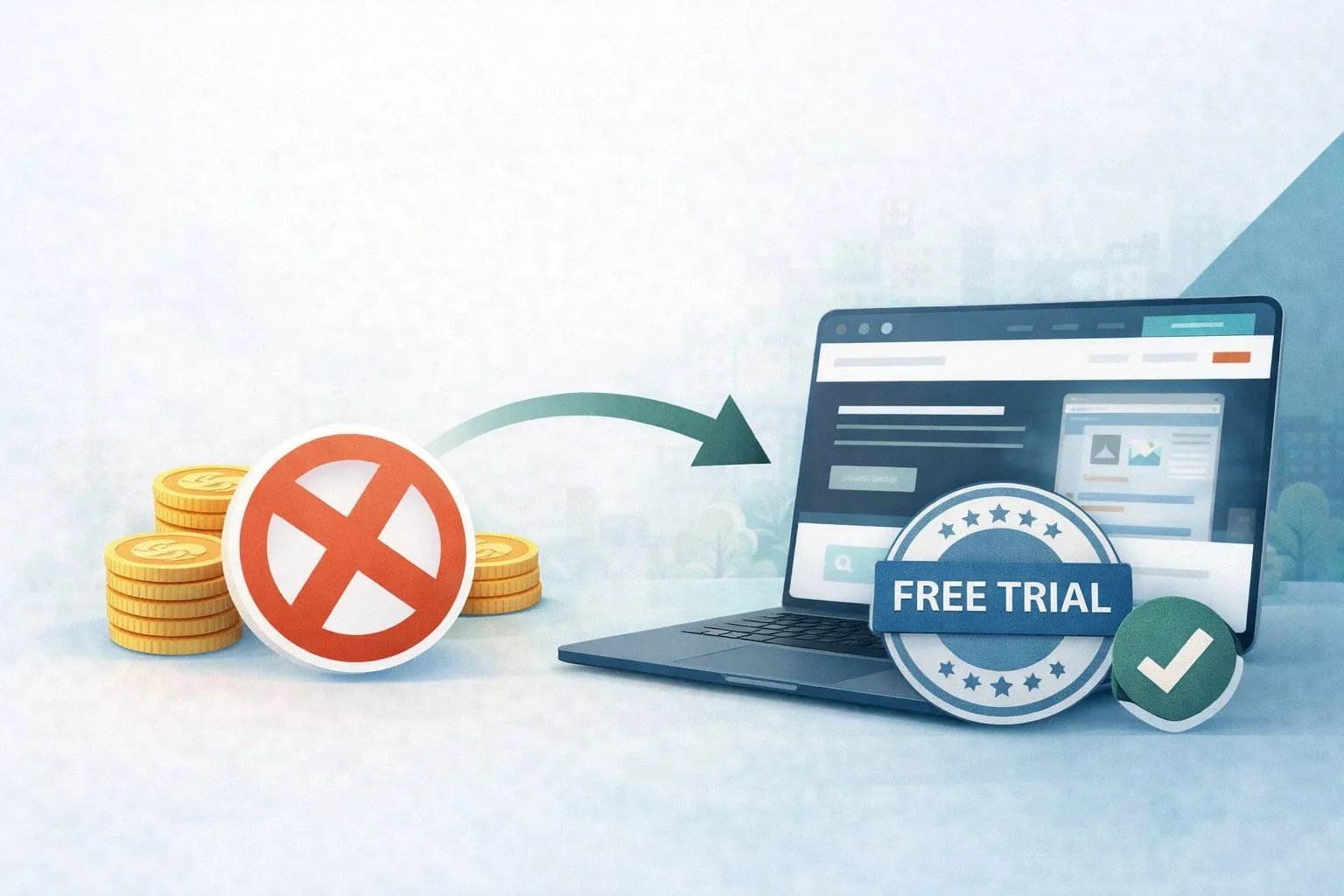
Stop Paying Upfront: Try Before You Buy Website Design
Avoid high upfront agency fees with a try-before-you-buy website model built for local businesses that need trust, flexibility, and predictable pricing.
By WeGotSites Editorial, Founder at We Got Sites
You don't need another sales pitch. You need something you can trust.
Because if you've ever asked a web agency for help, you've probably heard the same thing: “It's $3,000 to $10,000 upfront.”
And they want it before you've seen a homepage. Before you've seen your services. Before you've seen how they're going to make your phone ring.
That upfront deposit isn't “normal.” It's the agency asking you to carry all the risk.
I'm George Suarez, founder of WeGotSites in the San Francisco Bay Area. I built WeGotSites for the backbone of the US, which are small businesses. Local service businesses. Family businesses. Minority-owned businesses. People building something real without a safety net.
My promise is simple.
You don't pay upfront. You try it first. You pay only if you like it.
Wegotsites
Start My Free Website Preview
Takes ~2 minutes. No commitment. No credit card required.
Start My Free Website PreviewNo commitment. No credit card required.
Why upfront feels heavy
I come from a family of small business owners. I've seen what big “business expenses” actually mean at home.
That money can be bills. That money can be groceries. That money can be your kid's tuition. When an agency asks you for thousands upfront, they're not just asking for a deposit. They're asking you to bet on them.
And the scary part is you still have questions. You don't know if the website is going to be good. You don't know if it will reflect your work. You don't know if it will help you get more clients.
That fear is rational.
Nearly 39% of U.S. small businesses have less than one month of operating expenses saved [web:58]. So a big upfront payment doesn't just “sting.” It can put you in a hole.
And when cash gets tight, it gets tight fast. 51.3% of owners say they'd tap cash reserves within 48 hours to make payroll during a crunch [web:59].
So when I hear an agency say, “If you're serious, you'll pay the deposit,” I don't respect that. I don't see seriousness. I see risk getting shoved onto you.
What agencies miss
A lot of web design advice is made for companies with buffers.
Enterprise businesses can survive a bad vendor. They have budget. They have staff. They can eat mistakes and keep going.
Most local service businesses don't have that luxury.
You're running lean on purpose. You're protecting capital on purpose. You're building something for your family. That's why the standard agency model feels restrictive, especially if you've ever been burned before.
And yes, some agencies are great. Some agencies earn what they charge.
But there's a real problem in this space too. A lot of agencies sell “custom” while secretly using templates. They copy and paste. They swap out colors. They change a few words. Then they charge like it was built from scratch.
That's why people end up feeling trapped. They paid thousands, and now they're stuck with something generic. Or they're stuck with a site they don't like, and every little edit becomes another invoice.
And when contracts get involved, it gets worse. Other agencies lock you in because they want to have your money forever. They don't want you to leave them. They want to continue to get rich off you at any expense.
I'm not building that kind of company.
Websites should create calls
Here's what I care about more than anything: conversion.
A website can be beautiful and still do nothing for your business. A website can be a “work of art” and still fail at the one thing you actually need.
Your customer is on their phone. They're busy. Sometimes they're stressed. They're not showing up to admire design trends.
They're showing up to answer one question: “Can you fix my problem?”
That's why we build mobile-first. That's why we build contact-first. That's why we keep things simple and clear.
People bounce from websites really quick. If your site is overloaded with information and doesn't answer the basic questions fast, it pushes people away. I despise that style of website. It hurts your eyes, it wastes your time, and it wastes the customer's patience.
What customers need fast
If someone lands on your site, they need clarity immediately.
They need to know if you serve their area. They need to know what type of work you do. And they need an easy way to contact you right now.
I'll give you the plumber example I always use. If a homeowner has a burst pipe, they're not reading paragraphs. They're scanning for location, services, and a fast way to schedule or call.
That's the hierarchy. That's the game.
Trust signals beat fancy design
Some websites are ugly and profitable. That's real.
Trust matters more than polish in a lot of local markets. The “blue collar aesthetic” is a thing. A simple website that feels honest and easy to use can beat a fancy site that feels confusing or fake.
Now, your market matters too. If you do high-end construction in a wealthy area, people expect your site to reflect your work. Visuals become part of the trust.
Either way, you still need the same outcome. You need people to feel confident hiring you.
Photos and reviews win
People love to say, “I get all my work from referrals.”
Cool. Referrals still matter.
But most customers don't stop at one name anymore. They collect a few recommendations, go online, compare, and choose the business that gives them the most confidence.
I learned that personally after moving to a new city. Friends gave me barbershop recommendations. I trust my friends. I still didn't go, because I couldn't find photos of the cuts online.
No proof, no decision.
That's why I hate stock photos of people shaking hands. It's filler. Real photos of your work win every time.
Reviews matter too, and the data backs it up. 85% of consumers say they're more likely to use a business after reading positive reviews [web:17]. Then 54% of consumers visit the website after reading a positive review [web:17].
Your website is where the decision gets finished.
And it's not just browsing. 93% of consumers have made a purchase after reading online reviews [web:17].
So if your website is weak, you're leaking money. You're letting that trust momentum die on impact.
Most small business websites exist, but they don't do much
This part surprises owners.
The NFIB found 82% of small businesses have a website [web:62], but only 19% accept payments through it [web:62].
I'm not saying every local service business needs online payments. A lot of you sell quotes and booked appointments, not products.
The point is this: having a website doesn't mean it's being used like a real tool. Most sites are sitting there like a brochure. They don't drive action. They don't make it easy to book. They don't make it easy to call. They don't feel alive.
That's the gap WeGotSites fills.
Why I built WeGotSites
My career has been in tech, startups, and SaaS. I've spent years working with mid-market and enterprise companies, helping them grow using technology, systems, and data.
Over time, something became very clear to me.
The tools and strategies that help larger companies win online are incredibly powerful. But most local businesses never get access to them.
Not because they don't want to.
Because the system was never designed for them.
Family-owned businesses. Brick-and-mortar shops. Local business owners who are excellent at what they do but often get left behind when it comes to technology.
Many are stuck with an outdated website, an expensive agency, or no website at all.
WeGotSites was built to change that.
I believe local businesses deserve access to the same tools and advantages larger companies use, but at a price that actually makes sense for them.
That's why I'm taking everything I've learned working with larger companies and using it to help local businesses compete online.
Because helping local businesses succeed means helping our communities grow.
Try before you buy
Here's the model.
We build a free custom preview of your website first. Then we walk you through it. Then you decide if you want to launch.
No deposit. No contract. No pressure.
When people ask, “What's the catch?” I answer the same way every time.
You don't pay unless you like it.
That's it.
Why preview-first works
A sales deck is talk.
A custom preview is proof.
When you see your business, your services, and your brand on a real website, the conversation changes. You're no longer guessing. You're judging something real.
That's why we see about a 90% conversion rate from our free preview walkthroughs to paid subscriptions. Personalization works. It makes a huge difference.
And for the price, it becomes a no-brainer. I've said it before and I'll say it again: it's so affordable that people feel silly not buying it.
How the preview works
First, you apply for a preview and tell us about your business. We review it to make sure it's a fit.
Then we build your preview. On the call, we walk you through it in about 20 minutes.
Camera on. Real conversation. I want you to know who you're working with.
If you love it, we launch. If you don't, you pay nothing.
If you hesitate, I'm not going to pressure you. I'll ask what's holding you back and let you tell me. Sometimes it's timing. Sometimes it's fear because you got burned before. Sometimes it's just not a priority right now.
Either way, I'd rather build a relationship than force a sale.
What you get each month
WeGotSites is a done-for-you service. You're not logging into a builder and figuring it out yourself. You message us, and we handle it.
Pricing runs from $99 to $199 a month. It's $0 upfront. It's month-to-month with no contracts. You can cancel anytime, because we want to earn your business every month.
At the $99 level, we build you a one-page custom website and include two design refreshes per year. If you need more pages and more flexibility, we have plans that go up to five pages, then up to ten pages, with more frequent design refreshes. On higher tiers, you can also get professional business email addresses.
We also include your domain and hosting so you're not juggling vendors.
If you don't have a domain, we buy and register a .com for you and handle the annual renewals. If you already own one, we connect it.
Hosting is included too, with SSL protection, daily backups, and a 99.9% uptime standard. Your site stays protected and stable.
And the part that keeps owners sane: we offer unlimited text and photo updates. Your business changes. Your website should be able to keep up without you getting hit with surprise fees.
Domain, hosting, and SSL
People make this stuff sound complicated on purpose. It isn't.
Your domain is your identity. It's your name on the internet.
Hosting is what puts that name online so people can actually find it.
SSL is security. It keeps your website protected and follows best practices so customers feel safe.
You don't need to be technical to run a strong business online. You just need the right partner.
The two traps that waste time
You can waste a lot of time trying to “save money.”
I'm not judging anyone who tries. I've built things myself too. I get it.
But I've seen two cycles repeat over and over.
“My nephew will build it on Wix for free”
This is the failure cycle I watch most.
If the site hasn't been built in six months, it probably won't be built in the next six months. Your nephew isn't focused on your business. They have their own life.
Even when a DIY site gets built, the next problem is quality. If it doesn't look aesthetically well, it can devalue your work in people's eyes. That's not vanity. That's how fast customers judge.
Then there's performance. A lot of DIY sites are words on a page. They're not optimized for your area. They're not optimized to convert. They don't guide people to call, book, or request a quote.
You end up with a website that technically exists, but doesn't grow the business.
“I already paid and I hated the website”
This one is painful, because it comes with distrust.
I had a customer who spent over $5000 with an agency because it sounded like a great deal. The agency built a really bad website. Then they weren't even open to making edits without him having to pay more.
That's why people show up guarded. I understand it.
When someone tells me they've been burned, I don't argue. I ask what they wanted the website to do. I ask what didn't work. I try to understand the real pain point.
Then I show them a preview. Free.
That's how you lower someone's guard without using pressure. You remove the risk and let the work speak.
Updates still need boundaries
Owners ask me this all the time: “What if I want to change things constantly?”
You're allowed to care about your brand. You're allowed to tweak.
We make it very clear what each plan includes. Unlimited updates covers text and photos. If you want bigger layout changes, new pages, or more complex work, that can mean moving up to a higher tier.
Clarity prevents problems. It keeps everyone aligned.
And at the end of the day, the goal is to make you happy and get you what you need.
Support that feels human
I don't try to sound “techy” when I talk to business owners. I talk like a regular person. I want to understand what's important to you and what you need.
And we meet you where you are.
If you like calls, we do calls. If you like texting, text us. If voice notes are easier, send voice notes.
We also run a specialized team. Developers focus on keeping sites up and stable. Sales handles calls and relationships. So if it's Friday at 4 p.m. and one client has a typo and another site goes down, no one gets ignored.
That's part of bringing that enterprise feeling for these small businesses.
What actually drives revenue
A website is a tool. It needs a system around it.
Two systems matter a lot for local service businesses.
The first is reviews. The second is speed to lead.
A practical review script
Here's what I tell owners.
Ask for the review right after you finish the job, when the customer is happiest. Make it easy. Then give them a reason to do it now.
One simple move is a coupon code. Tell them, “If you leave us a review, your next appointment gets a discount.” Keep it clean and simple.
And if you care about keywords, don't obsess. Just coach customers to mention what you did in the review. If you fixed a water heater, have them say that naturally. Those words help you show up when people search.
Speed to lead
Sometimes the website works, the phone rings, and the owner doesn't answer. That's not because you don't care. You're on a job.
So we build forms that collect the right details, so you can call back on your time.
We also have an add-on product that can automatically answer phone calls and book appointments for you. That system exists for one reason: when you respond faster, you win more jobs.
Why I don't recommend chatbots for most local sites
I like AI. I use ChatGPT constantly. I'm building AI products too.
But chatbots on local service sites can hurt conversion.
When someone's in a crucial moment, they don't want to argue with a bot. They want a human. If they can't get help, they call the next company that answers.
That's why I focus on creating systems in place that increase human interaction, not systems that hide you behind automation.
The bigger mission
Most small businesses already use tech. The U.S. Chamber reports 95% of small businesses use at least one technology platform [web:63]. And 86% said technology was their lifeline during COVID [web:63].
So this isn't about convincing you technology matters. You already know.
It's about access. It's about not getting priced out. It's about not getting taken advantage of.
The NFIB found 57% of small businesses introduced new or improved technology in the last two years, but the gap is real [web:65][web:68]. Only 51% of firms with 1 - 9 employees did it, compared to 75% of firms with 50+ employees [web:65][web:68].
That's how small businesses get left behind.
And when owners do adopt tech, it helps. 65% reported technology helped them stay competitive [web:65].
My whole mission is making technology and resources accessible for everyone. You shouldn't need a huge budget to look professional. You shouldn't need to risk your family's stability to get a website that represents your work.
Where WeGotSites is going next
Long term, I want to leverage AI so customers can make more changes in real time, including complex changes. My goal is for AI to eventually replace our team from building these websites.
That's not about cutting corners. It's about speed and access.
But the human part stays. Trust stays. Relationships stay.
Final word
If you're tired of deposits, contracts, and vague promises, I built this for you.
You deserve a chance to win. You deserve to see what you're buying. You deserve to keep control of your cash.
So here's the deal.
Apply for a free custom preview. We'll build it. We'll walk you through it. Then you decide.
Best, George Suarez Founder, WeGotSites
Frequently Asked Questions
What happens if I don't like the preview?
You walk away and pay nothing. I know 51.3% of owners would tap cash reserves within 48 hours for payroll [web:59]. I refuse to add to that stress. If the preview doesn't fit your brand, there is zero pressure, no invoice, and absolutely no hard feelings.
Are there hidden setup fees when I launch?
Absolutely not. Traditional agencies love burying hidden setup costs, but we do exactly what we promise: $0 upfront. Your only cost is the flat $99 to $199 monthly fee. You shouldn't have to risk your family's financial stability just to get a professional, high-converting digital presence.
Do I own my domain name if I cancel?
Yes, you always own your domain. Other agencies use vendor lock-in to trap you, but I despise that practice. If we register a custom .com for you, it is yours to keep. We operate strictly month-to-month with no contracts because we must earn your business every month.
How long does it take to see my preview?
We move fast. Once you apply, we build your custom preview in just a few days. Then, we jump on a quick 20-minute video call to walk you through it. No months of waiting, no endless emails - just rapid, transparent results you can actually see.
Why shouldn't I just build a DIY site instead?
DIY wastes your most valuable asset: time. Data from NFIB shows 82% of small businesses have a site [web:62], but most act like dead brochures. We handle the design, hosting, SSL, and unlimited photo updates so you can focus entirely on running your actual business.