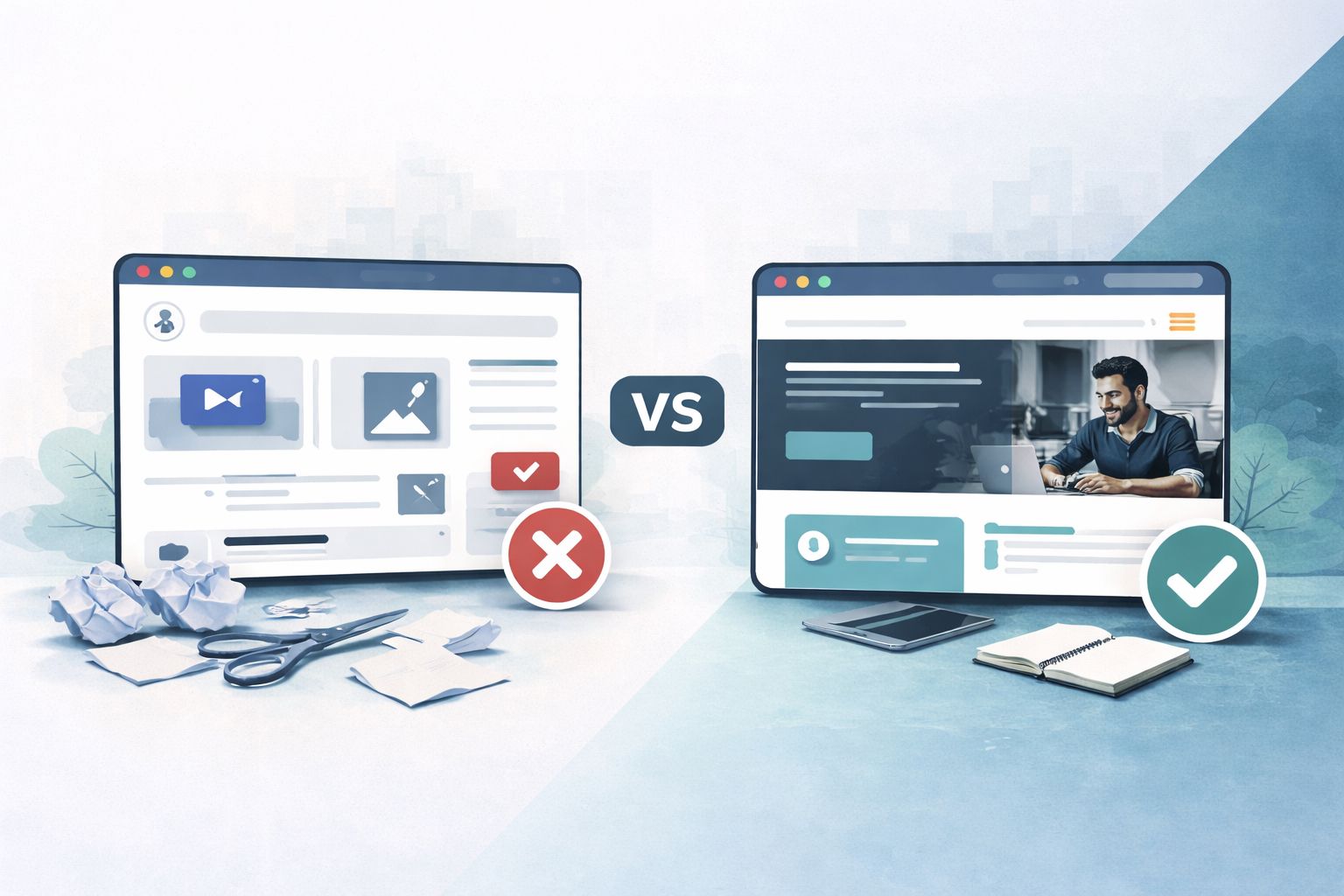
Wix vs Professional Web Designer: Is DIY Worth It?
Is your Wix site quietly losing you local jobs? Stop looking amateur. Get a custom, high-converting site for $0 upfront. See a free preview before you pay.
By WeGotSites Editorial, Founder at We Got Sites
Wix vs Professional Web Designer: Is DIY Worth It?
You've probably heard this advice from a friend, a cousin, or some business coach online:
"Just throw up a Wix site. Keep it cheap. Fix it later."
I get why that advice sounds good. When you're bootstrapping, you're protecting every dollar. You're not playing games with your cash flow. A lot of the time, you depend on this money to survive, to put food on the table.
But here's the problem.
A website isn't a "nice-to-have" anymore. It's the place where people decide if you're real. It's where referrals go to double-check you. It's where a stranger decides whether to call you... or call the next company on the list.
I'm George Suarez, Founder of WeGotSites. I spent years building startups and selling in AI and SaaS. Now my mission is helping the backbone of the US, which are small businesses. Regular people. Families. Owners who didn't grow up with the kind of resources and connections that feel like opportunities people just wake up with.
So when someone asks me "Wix vs a professional web designer," I don't answer it like a tech guy.
I answer it like a business owner. Because that's what matters.
The real question you're trying to answer
Most people think the question is: "Can I build a website myself?"
Most of the time, the honest answer is yes. Wix is easy enough to use. If you're willing to put in the time, you can get something online.
But that's not the decision that moves your business forward.
The real question is: "Will this website help me get more calls and bookings?"
That's it.
A website can look fine and still lose you money. Quietly. Every week. Because it doesn't build trust fast enough, and it doesn't make it easy for people to take the next step.
And you usually don't notice, because you're busy running the business.
The internet is not patient (and your customers aren't either)
People bounce fast. Especially on mobile. Especially when they're stressed.
If someone is dealing with a burst pipe, an AC that died in the middle of summer, or a garage door that won't open, they're not in a browsing mood. They want to know three things immediately: do you serve their area, do you do the exact job they need, and how fast can they reach you.
That's why I build around what I call the 30-second test. Your customer should clearly understand what you do immediately in the first 30 seconds. Then they should feel enough comfort to scroll or book.
If your website doesn't pass that test, you don't get a second chance. They go back to Google and click someone else.
A quick reality check: people judge credibility online
A lot of owners still think, "I'm booked off referrals. My work speaks for itself."
Referrals are great. They usually mean you do amazing work.
But the market changed.
People don't just rely on one referral anymore. They ask a few friends. They build a short list. Then they look everyone up online and go with the service that makes them feel the most comfortable.
And the data backs that up.
DreamHost's local business trust index found that 69% of consumers say a website is essential for credibility, 45% say businesses without websites feel less "real," and 39% have declined to do business with a company specifically because it didn't have a website.
So when someone tells you "just DIY it," they're skipping the part where your website is basically your reputation on display.
What Wix gets right (and when DIY can be smart)
I'm not anti-Wix. Wix is a solid tool. It lowers the barrier to entry. If you're brand new and you need something online fast, DIY can be a reasonable move for a season.
And let's be honest - many small businesses are forced into that route because the traditional agency model feels impossible.
A Clutch survey found that 28% of small businesses spend $500 or less to build their site. That tells you what's happening in the real world. Owners are trying to make something work without risking their family's budget.
I respect that.
I just want you to see the tradeoffs clearly, so the DIY decision doesn't quietly cost you more than it saves.
The hidden costs of DIY (that don't show up on the invoice)
DIY usually doesn't hurt you up front. That's why it's so tempting.
It hurts you later. In time, stress, missed calls, and lost trust.
Time feels free until you realize what it's stealing
When you're building a site yourself, the actual "drag and drop" part is the easy part.
The hard part is everything around it. What do you say at the top of the homepage? Which services do you list? How do you organize it so people don't get confused? What photos do you use? How do you make it look clean on mobile?
You end up doing marketing work, design work, and copywriting work... after doing a full day of running your business.
I plan my days by setting my top three priorities, because that's how you win as an owner. If "fight with Wix" keeps stealing your top three, you're paying for it. You're just paying with time instead of dollars.
A DIY site can make your work look cheaper than it is
This is one of the most painful things I see.
I've seen businesses that do amazing, amazing work. Then someone looks them up online and the website quality doesn't describe the work they do. It feels amateur. Their website doesn't match the quality of their actual work.
So they lose the booking right there.
Not because they're bad at the service. Because their online presence makes people second-guess them.
I've even experienced this as a customer. I moved to a new city and friends gave me barbershop recommendations. I still didn't book, because I couldn't find online photos showing the haircut quality. The word-of-mouth was there, but the proof wasn't.
That's how people behave now. They want receipts. They want visuals.
DIY sites often fail on mobile, even when they "look fine" on desktop
Your customers are on their phones. They're calling between meetings. They're scrolling in a parking lot. They're searching while they're frustrated.
Mobile is not an extra feature anymore. It's the main experience.
A Clutch survey found that 81% of small business websites were mobile-friendly, and with the businesses planning mobile optimization, that number was about 94% by 2019. That's the standard.
So if your DIY site is clunky on mobile, you're behind before the customer even reads your first sentence.
Updates don't happen, and that's where the damage stacks up
The website might launch. Then life hits. Jobs, kids, employees, scheduling, invoices.
So the site sits.
Now your hours are wrong. Your photos are old. Your services changed. You added a new offer. You moved locations. None of it gets updated.
And there's another angle here that people don't talk about enough. With AI tools being so accessible now, a lot of inexperienced people are building automated systems that create technical vulnerabilities. They don't mean to. They're just moving fast.
That's why I'm big on best practices and protection. A local business website should be simple, but it still needs to be secure and cared for.
Word-of-mouth still matters. Reviews matter even more than you think.
If you're in local services, reviews are your digital word-of-mouth.
And customers read them. A lot.
BrightLocal's research shows that 75% of consumers always or regularly read online reviews when researching local businesses, and only 3% say they never read reviews. Another BrightLocal stat I love: 46% of consumers trust online reviews as much as personal recommendations.
That's why I don't get obsessed with "keywords" in a vacuum. I want to know why you care about keywords, then I'll show you how to win with what you already have.
One simple move: when a customer is happy right after the job, ask for the review right then. Incentivize it. Create a coupon code and say, "If you give me a review, your next appointment you get X percentage off."
And when they write the review, encourage them to mention what you actually did. That's where keywords show up naturally, and it makes you look better in Google's eyes without you trying to "hack" anything.
"My nephew can build it on Wix for free." Here's what usually happens.
I hear this one all the time, and I'm not offended by it. If your nephew can truly build you something strong, that's great.
But here's the cycle I see constantly.
The website doesn't get built for months. And if it hasn't been built in the last six months, it's probably not going to be built in the next six months. Not because your nephew is a bad person. He's just not running your business. You're not his priority.
Then let's say it finally gets built. The next problem is updates. You need changes. You need new photos added. You want to change an offer. Something breaks. Now you're waiting again.
And even if the site looks decent, most DIY builds miss the real point. They don't include best industry practices in copywriting and conversion. They're not built to convert. They're built to exist.
A website that exists is not the same as a website that books.
What you're paying a professional for (when they're actually good)
Some people think hiring a pro means paying for "better design."
Design matters, but it's not the whole story. A great professional is really getting you four things.
First, they're building around how customers decide. They're thinking about your ideal customer and how your ideal customer makes decisions. They remove the moments where people hesitate. They make the next step obvious.
Second, they're building trust fast. That usually means real photos, real reviews, real examples of your work. I see stock photos of people shaking hands as filler. Real pictures make the business feel real.
Third, they're keeping it simple. I hate websites that overload people with information and don't answer basic questions. If your site hurts people's eyes or makes them hunt for the phone number, you're pushing customers away.
Fourth, they're handling the boring technical stuff so you don't have to. Domain, hosting, SSL, backups, uptime, and basic protection shouldn't be a scavenger hunt.
If you've never had this explained in normal terms, here's how I break it down. Your domain is your identity, your name on the internet. Hosting is putting that name online so people can find you. SSL is the security layer that shows your site is protected and following best practices.
The agency model is why so many owners don't trust web design
If you feel skeptical, I understand. A lot of small business owners have been burned.
Traditional agencies will charge anywhere from $3,000 to $10,000 up front. Then they hit you with monthly fees. Then they lock you into contracts. They do it because they don't want you to leave them. They want to have your money forever. They want to continue to get rich off you at any expense.
To be fair, not every agency is like that. Some agencies do incredible work, and their pricing matches the effort.
But there are also agencies selling copy-and-paste template sites like they're custom builds. And when you need edits, they disappear or they charge you again.
One client told me they wasted $3000 on an agency that built a poor website and refused to make edits. That story is way too common. It's also why I built my model around removing risk.
So... is DIY worth it?
Here's my straight answer.
DIY is worth it if you're truly early, you have more time than money, and you understand you're building a starting point - not a growth engine. You also need to be honest about whether you'll actually keep it updated and improve it over time.
DIY starts costing you when your business is already getting referrals, and those referrals are checking you out online. That's when the website becomes the difference between "they called" and "they kept scrolling."
Because your customer is already comparing you to two or three other options. If your site looks amateur or confusing, they feel friction. They don't tell you. They just pick the company that made them feel comfortable.
If you use Wix, do these things so you don't sabotage yourself
Start at the top of your homepage. Don't start with a fancy slogan. Put your service area in plain language. Say what you do in one sentence. Make your phone number impossible to miss, and make it tap-to-call on mobile.
Then prove your work fast. Add real photos. If you have before-and-after shots, even better. People want to see what you actually do, not read 10 paragraphs about it. Keep it digestible.
Next, build for speed to lead. If someone calls and you miss it, have a simple form that captures their name, number, and what they need. That way you can call back on your time instead of losing them completely. I've even built systems for businesses where an add-on can answer calls and book appointments, because missed calls are missed money.
Be careful with chatbots. They can answer basic questions, but most of the time local service customers are stressed and want a human. If they can't get answers quickly, they leave and call the next company.
Finally, keep it simple. Don't overload your pages with distractions. Don't add features just because Wix offers them. Every extra thing is another chance for the customer to get confused and bounce.
Why I built WeGotSites the way I did
I built WeGotSites because I came from a family with limited resources, and I come from a family of small business owners. I know what it feels like when a "business expense" can turn into a family problem.
That's why I wanted to make an accessible pathway for local businesses to get an enterprise feeling website without having to make a massive upfront investment.
So we flipped the model.
We charge $0 up front. No contracts. You can cancel anytime. Plans range from $99 to $199 per month, and the goal is simple: make it so affordable that you feel silly not buying it, while still delivering something equivalent to what would normally cost thousands.
We also build a free custom preview before you pay. You don't pay a cent unless you like it. That's me putting myself in your shoes and removing as much risk as possible.
We build custom sites from the ground up. No templates. We custom-code because it gives us more control and helps reduce costs for customers. Hosting, SSL protection, daily backups, and uptime monitoring are included. Unlimited text and photo updates are included too, because businesses change. You should be able to grow without feeling like your whole wallet's on the line every time you need an edit.
And yes, I care about human connection. Camera on during calls. Real conversations. Texting is fine. Voice notes are fine. Whatever helps you move faster.
Final take
Wix can be a good starting tool. I respect anyone trying to save money and build something from nothing.
Just don't confuse "I have a website" with "my website helps me win."
If you're already doing great work and your website doesn't match that quality, you're going to keep losing jobs you should've gotten. And it's going to feel confusing, because you'll keep hearing, "Your business is great." Meanwhile the bookings don't show up the way they should.
You deserve a chance to win online. You deserve a website that makes people trust you quickly, makes it easy to contact you, and helps you get more clients without going into debt.
That's the whole point.
Best, George Suarez
Frequently Asked Questions
Who actually owns my website and domain if I use a DIY builder versus a professional?
With Wix, you rent their platform - you cannot export your site's code if you leave. A good professional ensures you own your domain outright. Never let an agency hold your domain hostage. If you leave, your name should always go with you.
Can a DIY website rank just as well on Google as a professionally designed site?
It can, but it is much harder. Ranking locally is about technical speed and trust. With 64% of small businesses having a website, according to Clutch.co, you are competing against optimized, professional sites built specifically to load fast and convert.
Are there hidden costs to using a 'cheap' DIY website builder?
Yes. The base price looks great, but they nickel-and-dime you for essentials. Want to remove their ads? Pay more. Need a custom domain? Pay more. Soon, you are paying premium monthly fees while still doing all the heavy lifting yourself.
Is it hard to transfer my business from a Wix site to a professional web designer later?
Moving your custom domain is simple, provided you actually own it. However, you cannot migrate the actual Wix design. A professional will rebuild your site from the ground up. This is actually a good thing - it is your chance to build for conversions.
Does having a custom business email actually matter for local service businesses?
Absolutely. Using an '@gmail.com' address immediately feels less credible. DreamHost data shows 45% of consumers feel businesses without proper web presences are less 'real'. A custom email signals you are a stable, established business, not just a weekend hobbyist.